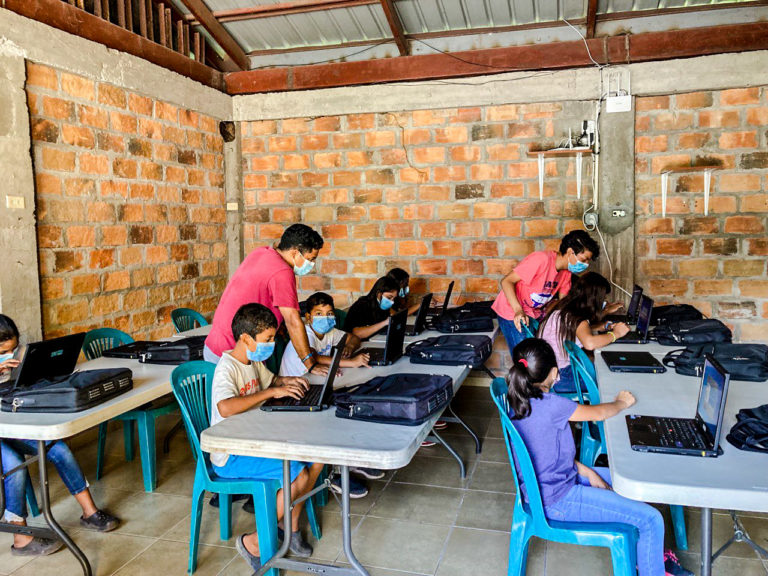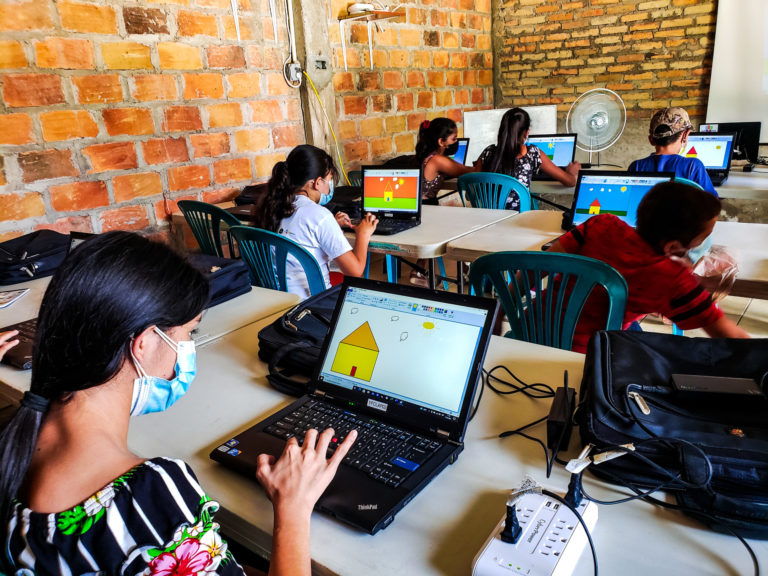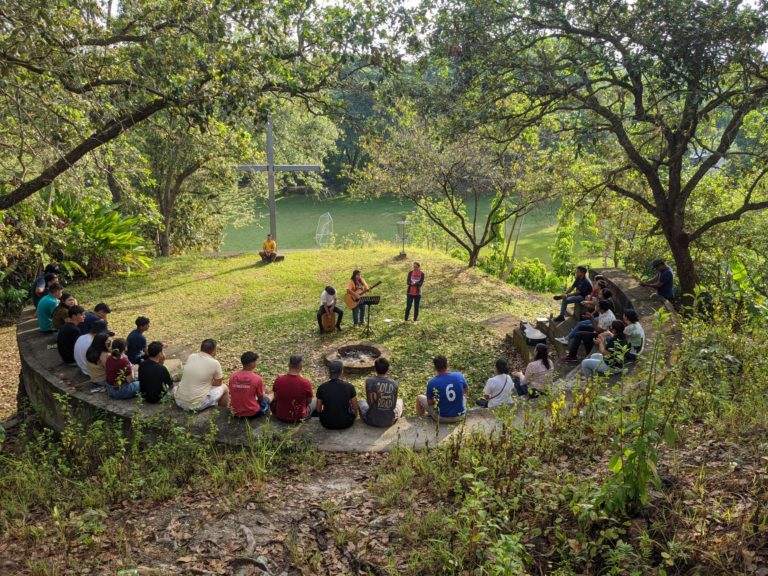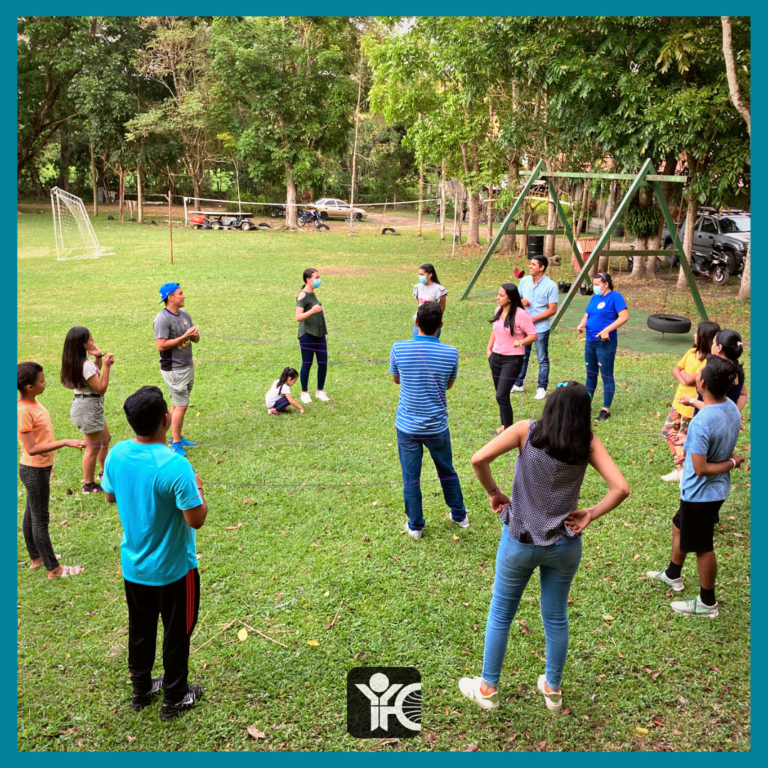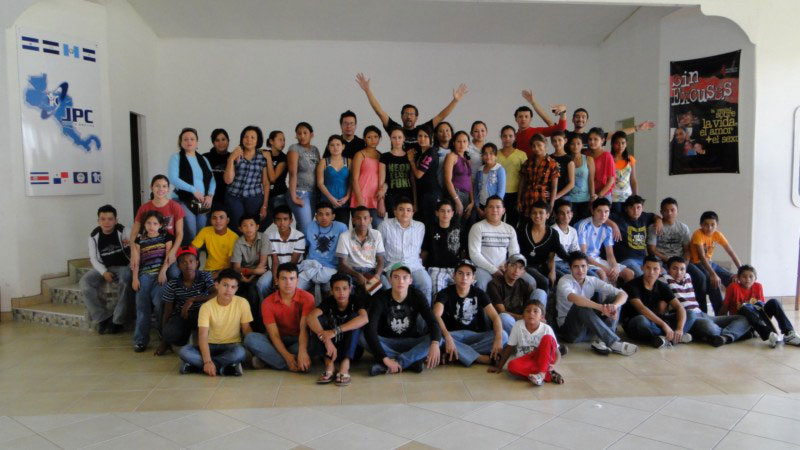
The CTI music ministry was able to perform 42 concerts with more than 10,800 youth in three different countries, with over 1,200 of them accepting Jesus in their lives. »
YFC Honduras shares about their 2011 ministry year, including photos and ministry reports related to Vacation Bible School, CTI Concerts Tour, and General Assembly »
A highlights video from a Soccer Camp in Honduras at which 55 young people improved their soccer skills while learning about Jesus and being challenged to live for Him. »
Young people who live on a mountain of rubbish in Tegucigalpa are receiving regular lunches, along with the good news of Jesus Christ. »
Because of you
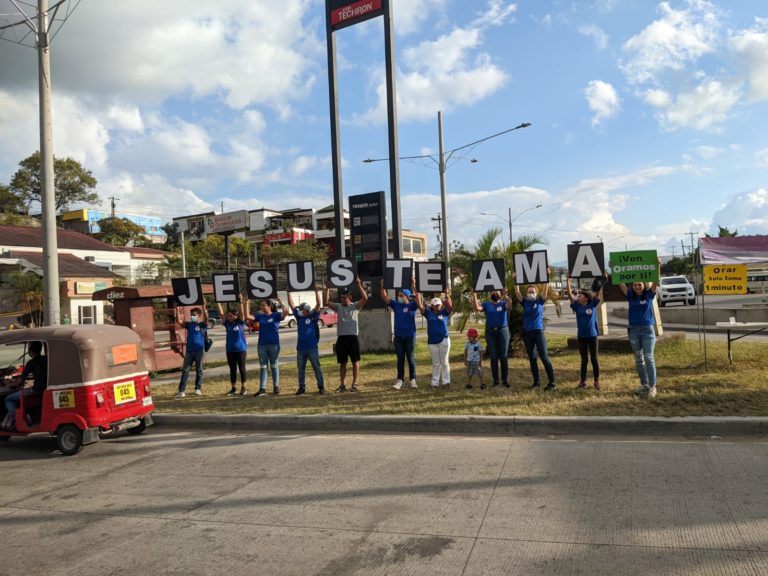
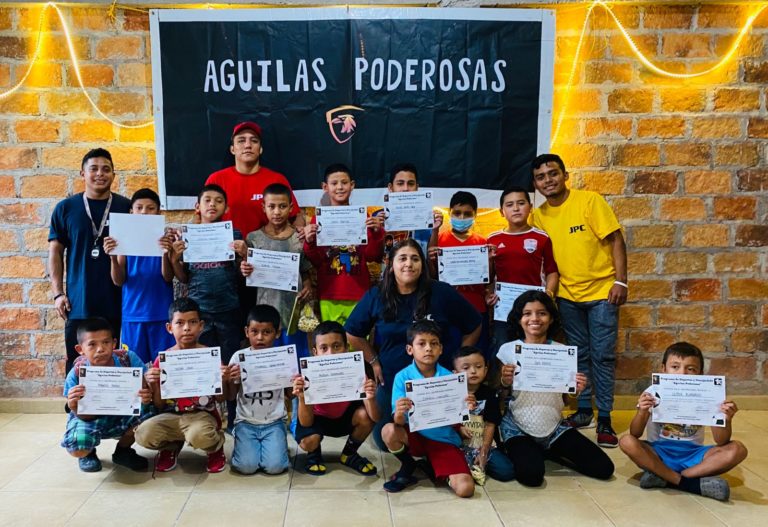
Youth for Christ practices “the fun way to serve God,” reaching the young people of Honduras through concerts, camps, workshops, sports days, social work, and leaders training.
Each year the Gospel of Jesus Christ is introduced to more than 6,000 young people.
Youth for Christ commenced with a Leader’s Training Camp in 2011 which included 40 leaders from different cities and different churches. The last day they motivated the young people to form their own clubs and camps, offering support when they needed it.
In 2010, Youth for Christ had ten camps with youth living in high risk zones, from which 332 accepted Jesus as their Saviour.
Youth for Christ worked elbow to elbow with Carpenters Tools International and performed 34 concerts in six cities (Tegucigalpa, Copan, Paraiso, Cortes, San Nicolas, San Pedro Sula), taking the message of God to 5,868 young people. Thanks to CTI!
In 2009, Youth for Christ pioneered the 1st Central American camp of the year. The 2010 Camp was developed in the country of Guatemala. This year (2011) it will be held for the second time in Rancho Vida Camp in Honduras.
Youth for Christ volunteers in Honduras also do social work with the children in need of love, support, and prayer.
This year included a celebration of “Friends Day” with 36 children that are HIV positive, giving them a joyful time with live music, piñata, cakes, pizza, and a Christian magic show. Youth for Christ shared half of the business donations with Nueva Esperanza Home (Children and Family Honduras Institute).
In September 2010, Youth for Christ worked alongside Angelitos Mache team and prepared a joyful time, collecting donated goods for Nueva Esperanza Home’s children in great need.
In June 2010, Youth for Christ worked along with Project TeamWork (PTW) who constructed a playground for more than a 300 children of Santiago, Pimienta village. During seven days of construction the rest of the team helped with Vacation Bible School for all the children.
In February 2011, Youth for Christ participated in an evangelistic campaign in one of the most risky areas of San Pedro Sula. JPC La Banda was the first to play that night; we also had two more bands and fireworks after sharing God’s World with more than 100 people attending.
Youth leader trainings are done four times a year during trips around the country to know more of God’s Creation.
To view a more detailed ministry summary of Youth for Christ in Honduras, click here.
Prayer Needs
Training team for volunteers and board members.
Curriculum for Youth leader training.
Funding and resources, specifically for school clubs.
Sample projects and ministry models that can evaluated and emulated.
About Honduras
Honduras
Introduction
Once part of Spain's vast empire in the New World, Honduras became an independent nation in 1821. After two and a half decades of mostly military rule, a freely elected civilian government came to power in 1982. During the 1980s, Honduras proved a haven for anti-Sandinista contras fighting the Marxist Nicaraguan Government and an ally to Salvadoran Government forces fighting leftist guerrillas. The country was devastated by Hurricane Mitch in 1998, which killed about 5,600 people and caused approximately $2 billion in damage. Since then, the economy has slowly rebounded.
Geography
Location
Location: Central America, bordering the Caribbean Sea, between Guatemala and Nicaragua and bordering the Gulf of Fonseca (North Pacific Ocean), between El Salvador and Nicaragua
Geographic Coordinates: 15 00 N, 86 30 W
Area
Total Area: 112,090 sq km Rank: 102
Land Area: 111,890 sq km
Water Area: 200 sq km
Comparison: slightly larger than Tennessee
Land Boundaries: 1,520 km
Bordering Countries: Guatemala 256 km, El Salvador 342 km, Nicaragua 922 km
Coastline: 820 km
Climate
subtropical in lowlands, temperate in mountains
Terrain
mostly mountains in interior, narrow coastal plains
Total Freshwater withdrawal (domestic/industrial/agricultural): 0.86 cu km/yr (8%/12%/80%)
Freshwater Withdrawal Per Capita: 119 cu m/yr (2000)
Environment
Natural Hazards: frequent, but generally mild, earthquakes; extremely susceptible to damaging hurricanes and floods along the Caribbean coast
Environmental Issues: urban population expanding; deforestation results from logging and the clearing of land for agricultural purposes; further land degradation and soil erosion hastened by uncontrolled development and improper land use practices such as farming of marginal lands; mining activities polluting Lago de Yojoa (the country's largest source of fresh water), as well as several rivers and streams, with heavy metals
Environmental Agreements: Party to: Biodiversity, Climate Change, Climate Change-Kyoto Protocol, Desertification, Endangered Species, Hazardous Wastes, Law of the Sea, Marine Dumping, Ozone Layer Protection, Ship Pollution, Tropical Timber 83, Tropical Timber 94, Wetlands
Geography Notes
has only a short Pacific coast but a long Caribbean shoreline, including the virtually uninhabited eastern Mosquito Coast
People
Population: 7,833,696 Rank: 93
Note: estimates for this country explicitly take into account the effects of excess mortality due to AIDS; this can result in lower life expectancy, higher infant mortality, higher death rates, lower population growth rates, and changes in the distribution of population by age and sex than would otherwise be expected (July 2010 est.)
Capital: Tegucigalpa Geographic Coordinates: 14 06 N, 87 13 W
Administrative divisions
18 departments (departamentos, singular - departamento); Atlantida, Choluteca, Colon, Comayagua, Copan, Cortes, El Paraiso, Francisco Morazan, Gracias a Dios, Intibuca, Islas de la Bahia, La Paz, Lempira, Ocotepeque, Olancho, Santa Barbara, Valle, Yoro
Independence: 15 September 1821 (from Spain)
National holiday: Independence Day, 15 September (1821)
Constitution: 11 January 1982, effective 20 January 1982; amended many times
Legal system: rooted in Roman and Spanish civil law with increasing influence of English common law; recent judicial reforms include abandoning Napoleonic legal codes in favor of the oral adversarial system; accepts ICJ jurisdiction with reservations
Suffrage: 18 years of age; universal and compulsory
Executive Branch
Chief of State: President Porfirio LOBO Sosa (since 27 January 2010); Vice President Maria Antonieta Guillen de BOGRAN (since 27 January 2010); note - the president is both the chief of state and head of government
Head of Government: President Porfirio LOBO Sosa (since 27 January 2010); Vice President Maria Antonieta Guillen de BOGRAN (since 27 January 2010)
Cabinet: Cabinet appointed by president
Elections: president elected by popular vote for a four-year term; election last held on 29 November 2009 (next to be held in November 2013)
Election Results: Porfirio "Pepe" LOBO Sosa elected president; percent of vote - Porfirio "Pepe" LOBO Sosa 56.3%, Elvin SANTOS Lozano 38.1%, other 5.6%
Legislative Branch
unicameral National Congress or Congreso Nacional (128 seats; members elected proportionally by department to serve four-year terms)
Elections: last held on 29 November 2009 (next to be held in November 2013)
Election Results: percent of vote by party - NA; seats by party - PNH 71, PL 45, PDC 5, PUD 4, PINU 3
Judicial branch
Supreme Court of Justice or Corte Suprema de Justicia (15 judges are elected for seven-year terms by the National Congress)
Politics
Political Parties and Leaders: Christian Democratic Party or PDC [Lucas Evangelisto AGUILERA Pineda]; Democratic Unification Party or PUD [Cesar HAM]; Liberal Party or PL [Roberto MICHELETTI Bain]; National Party or PN [Antonio ALVAREZ Arias]; Social Democratic Innovation and Unity Party or PINU [Jorge Rafael AGUILAR Paredes]
Political Pressure Groups and Leaders: Beverage and Related Industries Syndicate or STIBYS; Committee for the Defense of Human Rights in Honduras or CODEH; Confederation of Honduran Workers or CTH; Coordinating Committee of Popular Organizations or CCOP; General Workers Confederation or CGT; Honduran Council of Private Enterprise or COHEP; National Association of Honduran Campesinos or ANACH; National Union of Campesinos or UNC; Popular Bloc or BP; United Confederation of Honduran Workers or CUTH
International Organization Participation: BCIE, CACM, FAO, G-77, IADB, IAEA, IBRD, ICAO, ICCt, ICRM, IDA, IFAD, IFC, IFRCS, ILO, IMF, IMO, Interpol, IOC (suspended), IOM, ISO (subscriber), ITSO, ITU, ITUC, LAES, LAIA (observer), MIGA, MINURSO, NAM, OAS (suspended), OPANAL, OPCW, PCA, PetroCaribe, RG (suspended), SICA, UN, UNCTAD, UNESCO, UNIDO, Union Latina, UNWTO, UPU, WCO (suspended), WFTU, WHO, WIPO, WMO, WTO
Flag Description: three equal horizontal bands of blue (top), white, and blue, with five blue, five-pointed stars arranged in an X pattern centered in the white band; the stars represent the members of the former Federal Republic of Central America - Costa Rica, El Salvador, Guatemala, Honduras, and Nicaragua; the blue bands symbolize the Pacific Ocean and the Caribbean Sea; the white band represents the land between the two bodies of water and the peace and prosperity of its people
Note: similar to the flag of El Salvador, which features a round emblem encircled by the words REPUBLICA DE EL SALVADOR EN LA AMERICA CENTRAL centered in the white band; also similar to the flag of Nicaragua, which features a triangle encircled by the words REPUBLICA DE NICARAGUA on top and AMERICA CENTRAL on the bottom, centered in the white band
Economy
Economy Overview: Honduras, the second poorest country in Central America, suffers from extraordinarily unequal distribution of income, as well as high unemployment and underemployment. The economy relies heavily on a narrow range of exports, notably apparel, bananas, and coffee, making it vulnerable to natural disasters and shifts in commodity prices; however, investments in the maquila and non-traditional export sectors are slowly diversifying the economy. Nearly half of Honduras's economic activity is directly tied to the US, with exports to the US equivalent to 30% of GDP and remittances for another 22%. The US-Central America Free Trade Agreement (CAFTA) came into force in 2006 and has helped foster investment, but physical and political insecurity may deter potential investors. The economy is expected to register marginally positive economic growth in 2010, insufficient to improve living standards for the nearly 60% of the population in poverty. Despite improvements in tax collections, the government's fiscal deficit is growing due to increases in current expenditures from increasing public wages. Tegucigalpa lacks an IMF agreement; its Stand-By Agreement expired in April 2009 and former President ZELAYA's commitment to a fixed exchange rate undermined a follow-on.
Gross Domestic Product
GDP (purchasing power parity): $32.5 billion (2009 est.) Rank: 103
GDP - real growth rate: -2.1% (2009 est.) Rank: 149
GDP - per capita (PPP): $4,100 (2009 est.) Rank: 154
GDP - Composition by Sector: Agriculture: 12.2% Industry: 27.1% Services: 60.6% (2009 est.)
Labor Force
Labor Force: 3.327 million (2009 est.) Rank: 97
Labor force - by occupation: Agriculture: 39.2% Industry: 20.9% Services: 39.8% (2005 est.)
International Disputes: International Court of Justice (ICJ) ruled on the delimitation of "bolsones" (disputed areas) along the El Salvador-Honduras border in 1992 with final settlement by the parties in 2006 after an Organization of American States (OAS) survey and a further ICJ ruling in 2003; the 1992 ICJ ruling advised a tripartite resolution to a maritime boundary in the Gulf of Fonseca with consideration of Honduran access to the Pacific; El Salvador continues to claim tiny Conejo Island, not mentioned in the ICJ ruling, off Honduras in the Gulf of Fonseca; Honduras claims the Belizean-administered Sapodilla Cays off the coast of Belize in its constitution, but agreed to a joint ecological park around the cays should Guatemala consent to a maritime corridor in the Caribbean under the OAS-sponsored 2002 Belize-Guatemala Differendum; memorials and countermemorials were filed by the parties in Nicaragua's 1999 and 2001 proceedings against Honduras and Colombia at the ICJ over the maritime boundary and territorial claims in the western Caribbean Sea - final public hearings are scheduled for 2007
Evangelism, Church Planting in the South of France A team of people from Youth for Christ recently helped with a church planting mission, serving the community and sharing the Gospel. (Youth for Christ International)
Discipleship Ministries Strong in Lebanon Discipleship cell groups run a program for street children in Lebanon; youth leaders gather to train for youth work. (Youth for Christ International)
Czech Republic Offering Hand of Hope - Because Orphans Matter A camp for orphan children sees new openness to the gospel, in addition to providing discipleship opportunities for previous participants, and launching a dream to connect homes and churches to help orphans find true community and family within the body of Christ. (Youth for Christ International)